Tampilkan postingan dengan label The Farmer. Tampilkan semua postingan

Senin, 25 April 2011

Ask The Farmer 2011 - Day 1

We interrupt this month of Giveaways for some real content.... Thanks so much to all of you who sent questions about sheep farming to The Farmer. He spent a couple evenings scrawling out his answers and now it is my job to transpose it into something readable......  I didn't realize The Farmer had a "secretary" but I guess he does. If you had to wait for him to type it all, it might be next year for the answers!

I know that many of you who read this blog actually have agricultural lives but there are many more that reside far from any farm. Sharing our farming life has become the most rewarding and important part of this blog for my family and me. It's sometimes hard for me to determine exactly what to write about because I am in so deep and most of the things we do are part of a routine. This Q + A format works perfect. So here goes - Part 1 of 2011 Ask The Farmer.....

Selasa, 05 April 2011

When Will All the Flowers Begin????

I keep singing that song in my head with these words..... All around the blogosphere, I keep seeing flowers. We are still getting snow! In the last 5 days it has been white twice. But the snow did give me a chance to take some wintry photos of a pattern I am working on. Julia isn't quite as obliging as she used to be when I am taking photos. I've got to bribe her with money and then it is pretty torturous for both of us. Do you see the snow ball in her hand below? You can only imagine where it landed - at least it wasn't on my camera. Hard to believe it was April 1st, isn't it?


I received the prettiest little thing in the mail the other day from Robin in Minnesota. She came to the October "Get Stitched on the Farm" knitting retreat.


And a beautiful letter.
Dear Kristin, Attending your class in October of last year was one of the highlights of my year. It was so much fun! I've had more fun playing with color and feel a lot more confident. I've been knitting a lot, but I keep getting distracted with flowers. Here's one that reminds me of your sunflowers. Robin


What you can't see is Robin inserted a wire into the stem and the flower is totally bendable. It is exquisite and is cheering me up sitting in a little vase on my windowsill above my sink as I wait for something green to begin here. I was really tickled to receive this flower. As she was spending time at the farm last year, I could see her brain being turned on and a real creativity developing in her knitting. Robin is an accountant by training and letting loose doesn't come easy to her. As I sent her off into her knitting world, I could tell she really was taking away a lot of good information and that "I had gotten to her." To receive this little gift was truly special for me as a teacher. Thanks Robin!

I'm teaching the "Get Stitched Flower Class" in September here at our Farm. So far, there are no takers so I may have to cancel it and try something else. Or maybe the date is just bad. Or maybe noone wants to come.... There are only 2 spots left in the October 2/3 class so if you are on the fence, think about signing up soon.The July class is completely filled with a group of friends from Maryland. I'm looking forward to all the preparations, cleaning up the garden, airing out the house!

If you are looking for a nice Spring, Easter, or Passover gift to knit for friends, I must suggest my "Olympia's Knit and Crochet Flowers" pattern. (That is the pattern Robin used although she improvised a bit - yay Robin!) Who wouldn't like a knitted flower for a hostess gift or a centerpiece. I think maybe I will use my rustic basket with felted flowers as an Easter basket this year. 


The felted flowers also look beautiful when decorating a grapevine wreath. They are so quick to knit and totally addicting. A nice "carry around" project when it gets too warm to drag around big bags and heavy wool.


The pattern is available for $6.00 on my website via PDF Dowload here.

Don't forget to add your question to "Ask The Farmer." Either you all are too tired of reading the blog or don't have enough time in the day..... Or you are still working on your taxes like we still are. I've got a really busy week this week and next and I am hoping The Farmer will fill in for some of my posting.

Jumat, 01 April 2011

Ask The Farmer Returns!


Last year, I did a fun column called "Ask The Farmer." Now that lambing has slowed down a bit, I asked him if he would answer your farming questions here again. Miraculously, he obliged. So, if you have any sheep, lamb, farming, or sustainable agriculture related question for him, leave it in the comments section of this post or email me directly. It's okay if someone has asked the same question.... that way we will know what are the most important to answer. He will answer them over a series of posts, fitting it into our farming schedule.

More giveaways next week! If you are wondering who has won each giveaway, I've been adding to each post at the end of it once the contest is over. If you are looking for book ideas, check out all the comments in Tuesday's post. You all are a wealth of great information!

Senin, 27 September 2010

Around the Farm

Pokeweed is a nasty weed which I am constantly fighting. At this time of year it is so unbelievably beautiful. You can read all about the many uses for it here. I never knew it was so toxic. The sheep know because they never eat it. Me, I just want to knit this photo! And I will one day.


The ewes have been grazing up the road most of the summer. Can you see how brown the pasture is? You've probably heard about the lack of rain here on the east coast. I have been so nervous we are going to run out of water. It is just one of those things and you put up with it having a well. My brother-in-law David (the Other Farmer - he makes milk) ran out of water last week. Dairy cattle need a lot of water daily so he is driving to a pond at a neighbor's house that is spring fed and pumping water a few times a day to give to his cows. Today and tomorrow it is supposed to rain but we are so behind on the water that two days will help a little but not much. My Farmer is filling up his water tank and delivering the water from a local pond that still has water to the ewes out in the field.


The lambs have been in the pasture right outside our house for most of the summer. They really are growing, aren't they? Tonight we have to separate the largest ram lambs to take to the processor on Wednesday morning. Should be fun in the rain. The dogs will have a good time because they will be doing some real work. Rain or not, they live to work. And by the way, if you want a lamb for your freezer, I am taking orders now. Information is over here on our Leyden Glen Lamb website. I will most likely be coming to the Boston area sometime before Christmas so I can arrange a "lamb meat-up." You can also take a drive and pick it up here at the farm. Lamb meat is always available in our "lamb shack."

The colors here in New England are turning gold and red at an alarming rate. Color usually peaks around Columbus Day but it looks like this year we will be at full color this weekend. My guests for the last "Getting Stitched on the Farm" Class of 2010 are very lucky considering many are coming from parts of the country where there isn't as much color.


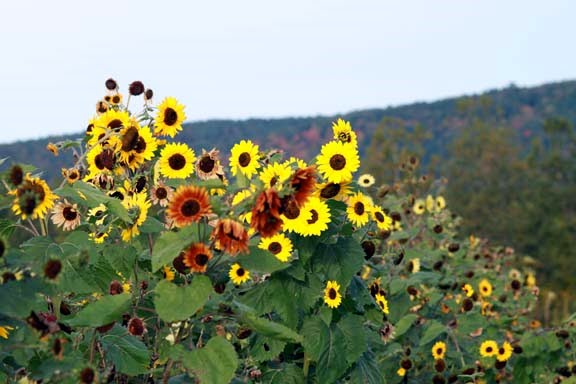
The sunflowers are still doing their thing. The hot weather has made for an amazing crop. I will really miss the daily picking of the field and filling the buckets for neighbors to buy and take home for their kitchen tables. I'm also going to miss having vases around the house overstuffed with sunflowers. But I must admit, I am really looking forward to a little downtime, nesting in our cosy house, knitting, getting my studio up and going, and possibly getting my feet clean again. It has been months since I have been able to get them squeaky clean.

Jumat, 12 Februari 2010

Going to Work

We listen to a great radio station here in “The Happy Valley” called WRSI. This morning, the D.J., Monte asked a caller what she was doing today. She said she worked nights as a waitress but during the day today she was going to be collecting compost and food for her worms to eat. The Farmer and I just looked at each other and grinned. Only here…..

Last weekend was the big “Winter Fare Farmer’s Market” in Greenfield. We didn’t have enough lamb to bother exhibiting and selling but we went anyway. Julia and I and 1500 others! What a huge turnout and a massive good time. I saw lots of farmer friends – including Jeanette at Chase Hill Farm, Warren of Our Family Farms Milk Coop, Kyle from Bostrom Farm, Gloria and Ervin from Coyote Hill Farm, and talked to many other farmers who I was just meeting. I bought fingerling potatoes, carrots, parsnips, green house raised lettuce and some wonderful cheese called Dutch Gold cheese. Do you have a Winter Farmer’s Market in your area? If you do, go – it’s a great time.

Here’s the scene this morning as The Farmer and No. 84 head off “to work.”

No. 84 is learning to be a sheep. It’s not easy and he doesn’t like it. He started going to the barn for an hour a day early in the week. Now he and The Farmer head off every morning and he spends the day at the farm with the rest of the sheep. He comes home at night and sits by the woodstove just hoping we will forget that he is supposed to be a sheep and not a sheep dog. That’s the problem with some bottle lambs. You need to get them right outside or they quickly become dog and cat-like. The other scary thing is they don’t have the instincts to run away from a predator. A little hard to teach a lamb that. We can only do so much – that’s why it is best to get the bottle lambs back with the flock quickly.

Sorry about the glare in the photo but at least the sun was out and shining and spring seems closer with every day. We got only an inch of snow during the past storm. I guess all of you down south are getting what we usually get. Good luck digging out. My advice to all of you is to do a lot of knitting!

Happy Valentine’s Day everyone.

Selasa, 26 Januari 2010

The Farmer Answers - Part Six

On Sunday, it was a beautiful sunny day. The little lambs love to sunbathe in the bright sun. The Farmer places the bales of hay in different spots for feeding. The sheep won't eat the entire bale so the end of it makes a perfect bed for everyone to nap on.


Farming Lesson of the Day: Docking Tails:

We use an
"elastrator" to "dock" the lambs' tails. This is done when they are a day old. A very small and very strong green rubber band is put on the tail using a special tool. The band cuts off the blood supply to the tail which will then fall off in a couple weeks. Here the band going on.


Here's what it looks like the first day.

This little lamb's tail is about to fall off. Can you see how it is shrivelled?

This year, The Farmer is "docking" all of the lambs' tails. In the past he only did the ewe lambs so it would be easy to identify the ram lambs that we used for our lamb business. This year he changed his mind for some reason. Having a short tail helps the sheep stay clean and free of manure. It is healthier in the hot humid summer when flies and maggots can infest a sheep and kill it quickly. Nothing more gross in the summer than a sheep infested with maggots. UUUUGGGHHH.

More from The Farmer Today

Question:
I have a question about the de-worming... I know that for horses the deworming is prevention only. If you de-worm too late and the horse already has worms, the horse will die because the de-wormer will kill the worms while they are in the horse's heart blocking blood flow. Is thie same thing true for the de-wormer you use on the sheep?
The Farmer Says: Sheep always have some worms in their stomach. Although there are several different types of worms (taper worms, round worms, etc.) it is round worms that tend to cause the most problems. Killing the worms will not kill the sheep or lamb. In fact, worming sheep when they have a relatively light worm burden is a waste of time and money. Also worming when it is not really necessary can increase the chance of worms building up resistance to the worming medicine. Drug resistance is becoming a very serious problem.

Question: Hey Farmer! We've been dying to send you a few questions: Which model MASSEY-FERGUSON are you using?
The Farmer Says: I have two Massey Ferguson tractors. The loader tractor which gets used the most is a Model 4235 60 horse power tractor. The larger tractor which is used for all the haying operations (mowing, raking, baling, etc.) is a 6480 120 horse power tractor.

These days all the major tractor manufacturers make a good tractor. I chose Massey Ferguson because we had a dealer in my town. The upstairs part of the business was a 100 year old general store. The downstairs part was the tractor dealership. If I was having a problem with my tractor, I would simply drive it down to Streeter's Store. While they were fixing the problem, I could go upstairs and buy an ice cream cone, some fish hooks for later and shoot the breeze with Whitey Streeter who made it his business to know all about your business. Sadly, Streeters closed its doors for the last time a couple years ago.
Kristin Says: I wrote about Streeter's Store several times on my blog. You can read about it here. It's funny but I get e-mails every once in a while about Streeter's Store - usually from people who lived in town long ago and wonder if it is still around. Happily, the building is being used again. There is a package store (for those of you not from New England, this means beer, wine and liquor) in one half of it and soon to be some kind of tea room if they can ever get the permits straightened out. Maybe I will write about that when it finally opens.


Question: Do you keep a count of all the sheep you've ever had on the farm? how many?
The Farmer Says: Although I don’t keep count of all the sheep I’ve ever had on the farm, I know that it’s quite a few.

Question: Which hat/sweater combo from Kristin is your favorite to wear?
The Farmer Says: I guess my favorite hat/sweater combo is the one I can find that morning.
Kristin Says: The man is in need of a new sweater. Several have moth holes in them. I must say, he isn't high on the list - I'm always working on something for upcoming publication. I must make that a priority. I do manage a hat once in a while.

Question: What's in your flask: Scotch or Jameson?
The Farmer Says: Although I don’t have a flask, a good single malt scotch or a very good cognac while sitting next to the fireplace sounds just fine.

Question: Have you ever thought of posing in a dedicated Farmer calendar? Like January in the Carhartt suit with twin lambs, February in the Carhartt suit with a red hat, March in the Carhartt suit slightly unbuttoned for the warmth - no hat, and so on, perhaps a couple of months with sweaters. Maybe one month with Jeremy, another with Eyeore, maybe one with the chickens. And the dogs. And the cats.... Semi-serious question. It would be part of the Kristin Nicholas/The Farmer/Julia family lifestyle series..... perhaps a reality show is a possiblity - The Farmer + Kristin + Julia + 200+ animals..... just free-thinking here...
The Farmer Says: I have to admit that I know who suggested that I pose in a dedicated Farmer calendar...... If I’m already starting to unbutton my Carhartt suit in March, I have a feeling that she will be unwilling to accept anything short of The Full Monty by Christmas. I guess I will be needing a lot of that really good cognac if I’m to follow through with this proposition.
Kristin Says: This is why I love my friends - Always thinking of ways we can make money and keep the farm afloat although some I'm pretty sure won't come to fruition!

The Farmer is almost done, only a few straggling questions to answer - if you want to send anymore questions, please do but make it early in the week. Several of you have asked this to be a regular column and we will try at different times of the year. Lambing is the most exciting time of the year (if taking care of little lambs is your kind of thing) here on the farm.

Senin, 25 Januari 2010

The Farmer Answers - Part Five

Wet cold rain today. No school for Julia. It was too icy for the school to send the buses out. Good choice, I must concur. The Farmer has been to the barn and no new lambs were born today. Thank goodness. Wet cold rain is harder for lambs than 10 degrees and snow. Yesterday it was a beautiful sunny day. Here's some new arrivals with The Farmer and "The Farmer's Daughter" looking on.

Back to the Q & A with The Farmer today.

Question: If you were not a farmer, then what would you like to do?
The Farmer Says: If I weren’t a farmer, then I think I would enjoy being a forester. It would be fun and rewarding to work with small landowners to advise them on how to improve their forests or woodlots. And what better office than to be out in the trees and wildlife.

Question: My husband, his sister and I just moved to a small farm (28 acres). How much does it take to sustain a flock of sheep? We're talking about meat and for fleece. (I want the fleece, they want the meat!)
The Farmer Says: I will have to make a few assumptions since I don’t know where your farm is. Assuming that it is in a part of the country where there is adequate moisture and the soil has at least a moderate fertility level, you should be able to stock the farm at 3 to 5 sheep per acre. If you have very fertile land and you practice pasture rotation, you could probably raise that by a few sheep.
When determining your stocking rate, it is also important to realize that grass doesn’t grow at a steady rate. In New England, our pastures usually start growing in April. The pastures reach their peak growth rates around the beginning of June and then slow down dramatically during the summer months. There is another smaller growth spurt in early fall. On our farm, I will sometimes graze over 100 sheep per acre but only for a day or even less. It is important to remove the sheep when the grass is grazed down to around 2 inches in height. The pasture should be rested until the grass reaches 6 to 8 inches in height.


Question: I purchased some Leyden Farm Lamb and it was wonderfully tasty stuff (even though the husband wouldn't touch it) but I noticed the congealed fat was yellow! I'd never seen yellow fat before - is that because there were no hormones and it was all grass fed?
The Farmer Says: To answer the question about the yellow fat, I contacted a fellow grass farmer who also works in the Agriculture Department at UMASS/Amherst. Kyle says that it is absolutely because the animal was grass fed. The carotene in the grass gives the fat the yellow color.
Kristin Says: Thanks for purchasing our lamb. At the moment, our supply of lamb is very low but we're hoping to do a better job next year anticipating customer's wants and needs. It's all one big experiment! We knew starting a retail lamb business would be full of all kinds of learning and we weren't wrong.

Question: When/How do you separate the lambs from their SheepMamas ? Is it hard for them ? Do you think the Mamas still recognize their babies from afar ?
The Farmer Says: I’m never in an particular hurry to separate the lambs from their mothers. I guess generally they come off their mothers at around 90 days. The exception to this is lambs sold for the Easter market who come off earlier. I guess this is a pretty relaxed system when compared with dairy calves that are removed from their mothers the first day of life.

The photo below shows The Farmer bringing in a new lamb with the mama close behind. The new lambs are held in these temporary pens for a couple days to help them bond with their mamas and to keep an eye on them. Sometimes it is impossible to bring a new lamb in - the mama just won't participate. If they are that wild, we just leave them alone (they have a real will to live as does their baby most likely).


Question: You use the term sustainable for your method of farming. Could you please explain more about what sustainable farming entails?
The Farmer Says: Sustainable farming means different things to different farmers. To me, it is sort of a web in which you are sensitive to the fact that many things are interconnected. Much of our land is hill land and therefore susceptible to soil erosion. We keep this land in permanent pasture to hld the soil in place. By careful planning of grazing and resting periods, we are able to build up the fertility organic material, and soil organisms such as earth worms, microorganisms and beneficial soil bacteria. Over time the soil improves rather than degrades.
The livestock raised on the farm should be suitable to the soil conditions, topography, and climate. My role as a grass farmer is to use the sheep as a tool to harvest the grass which is a result of photosynthesis and water and produce a saleable product in the form of meat and wool. Finally, in our case, we market the lamb meat at a price where we can make a reasonable profit. This is what sustainable farming entails on our farm.

Question: Do you have hired help? If so, who, how many, how much?
The Farmer Says: For the most part, we operate the sheep farm without hired help. Last summer I hired a twenty year old kid to rake a field of hay while I did the baling. I remember thinking that it was pure heaven. You’ve got to love 20 year olds. They can stay up partying all night and still be productive on a tractor the next day. It’s been a long time since I could do that.

Question: What breed(s) of sheep do you raise and why? If starting with a small flock, how many acres would be needed?
The Farmer Says: My flock is based on Romney sheep. Romneys are calm, reasonably productive and do well in a grass based operation. As I said in a previous question, you should easily be able to stock at 3 sheep per acre.

Question: Do you have any "milk" sheep - why or why not?
The Farmer Says: I don’t have any milk sheep. The idea of having to milk a flock of sheep twice a day gives me the hives. I would however consider introducing some milk sheep genetics into the flock toimprove the ewes milk production for their lambs. This can be a tricky proposition though. Too much milk sheep influence will give a poor lamb carcass. Too little milk sheep influence and you didn’t get the increased milk benefit that you were trying for.

Question:You said you started with Romneys; are all your sheep Romneys? Why this breed?
The Farmer Says: My flock is based on Romney sheep. Romneys are calm, reasonably productive and do well in a grass based operation. When we were beginning we had heard that they do well on New England hill farms.
Kristin Says: Our flock used to be only purebred Romneys but a few years into it, we learned that if we crossed our Romneys with other breeds the lambs would be hardier and have more will to live. Over the years we have experimented with different breeds by purchasing rams. Right now, we are using a Cheviot ram, a Border Leicester, a Shetland/Romney cross and a Romney ram. It is fun to see what the different babies look like and to watch how they do on our grass based pasture management system. This little guy who is so cute is probably mostly Romney. He does have brown ears and legs.


Question: I was wondering if you ever thought about making sheep's milk cheese. Too much trouble? No interest? wrong breed? I know little about sheep, but as I had always heard that they were not very friendly I wondered if sheep who were milked regularly become more easy to handle.
The Farmer Says: I don’t have any milk sheep. The idea of having to milk a flock of sheep twice a day gives me the hives. I would however consider introducing some milk sheep genetics into the flock toimprove the ewes milk production for their lambs. This can be a tricky proposition though. Too much milk sheep influence will give a poor lamb carcass. Too little milk sheep influence and you didn’t get the increased milk benefit that you were trying for.
Kristin Says: I just finished reading a great book called Goat Song. It is about a writer (Brad Kessler) and he and his wife's first year of goat farming and making cheese. I suggest it if you are interested in this kind of literature. A bit of it was a little too precious for me. Raising 4 goats as opposed to 200 plus sheep is a totally different thing.

We're not done yet - hope to be able to post some more of The Farmer's Answers tomorrow if time permits.

Kamis, 21 Januari 2010

The Farmer Answers - Part Four

Today's Lesson: Worming a Sheep

Sheep have to be wormed several times a year. I use a "worming gun" which has a metal tip on it. The worming liquid called Ivermectin is in the container which is on my back. I dial up the dosage depending on the weight of the animal and the gun automatically doses the liquid into the sheep's mouth when I squeeze the trigger. This is a similar treatment to when you treat your pets for worms. In the summer if sheep are not treated frequently, the worms can easily overwhelm them and they will die.


From Kristin: It was really busy here Wednesday. A dozen lambs born were born (lamb count now 114) and we had a friend's birthday party.

Not a lot of time to answer questions - sorry. Hopefully The Farmer will be able to answer some more tomorrow night. We've got a lot of stuff going on besides farming Thursday. Yikes!!!!

Here are two new twin lambs born Wednesday morning:


I love this photo of this little white lamb suckling its black mama.


The Farmer Answers - Part Four

Question: Is having a donkey watch over the flock better than a llama? I noticed only recently that you have a llama too but am wondering about the benefits of a donkey...
Another Similar Question: Why not two llamas or two donkeys? How come you have one of each? Different skill sets?
The Farmer Says: Often our flock of sheep is broken up into two or three grazing flocks. We try to have one guard animal with each flock. Both the llama and the donkey are somewhat effective in predator control although they are not fool-proof. We are looking into getting a guard dog possibly.
We don’t know too much about llamas or donkeys – we’re learning. What we have been told is if you have two llamas, they will be ineffective as guard animals because they are more interested in each other. Llamas are extremely social animals. As for the donkey, we don’t know if having two would be helpful or a hindrance. We’re happy with just one.

Question: What happens to the fleeces or lambskins from the butchered lambs? Does Adams dispose of them or do you get a share if they're sold? What happens to the carcasses and organs and other byproducts of lamb processing?
The Farmer Says: I’m not sure. I will have to ask Adams what they do with the lambskins and the other by-products. We get the hearts, kidneys and livers back and sell them. I know that if we wanted them back, we could get the sheepskins but would have to pay extra to salt them. We would then have to ship the salted skins to a tannery. Once again, it is a matter of economics and money. We have had sheepskins processed in the past for our own use but it is very costly. With cheap New Zealand imports, it would be hard to compete. Only so much money to be tied up……

Thank you all for your interest in our sheep farm and your fabulous questions!

Rabu, 20 Januari 2010

The Farmer Answers - Part Three

Today's Lesson: Piercing a sheep's ear for an eartag.

There are many different kinds of eartags for sheep. The one we are using at the moment is an old-fashioned tag called a Temple tag. It is small and not too visible. Kristin wanted me to use this type of tag so that it wouldn't show too much in her photos.

I use a special tool similar to a whole punch to pierce the sheep's ear.


The tag is fed through the whole in the ear. It doesn't hurt her. This tag will stay with the sheep for her entire life.


Question: I too would like to know about selling the fleece for spinning. Of interest is Wensleydale sheep ( I ordered locks from England because could not find any in US). Meat and fleece may not be compatible goods.
The Farmer Says: We are really concentrating on getting our retail lamb meat business up and going. Perhaps one day we will concentrate more on our wool but at this point we only have so much money to invest in developing our business.

Question: How is it having a wife who is so art oriented when you are so earth oriented? Do you LOVE the way she paints your rooms and your life? Seriously I love her colors!
The Farmer Says: I enjoy the fact that Kristin is art oriented. I enjoy art as well although not with Kristin’s level of passion. I feel that my sunflower field is my art. I tend to do things slow and methodical whereas Kristin thinks nothing of painting a room some wild design at 2:00 in the morning. Sometimes you just have to go along for the ride.

Question: Do you have a lawn that requires mowing?
The Farmer Says: Yes we do. Sometimes we use our sheep to mow the lawn. Other times we mow it. It depends where the sheep are and how fast the grass is growing.

Question: I'd like to know.... does the Farmer has another job off the farm or does he work full time raising sheep?
The Farmer Says: It would be impossible to feed and care for our family on the income from our sheep farm. I am self-employed and sell drilling supplies to excavation contractors. To say the last couple years has been challenging would be putting it mildly. Kristin works hard writing books, designing patterns, and teaching knitting. We are hoping that this year our farm contributes more to the income of our household, whether it through our lamb business or Kristin's knitting and stitching on the farm classes.
Kristin Says: I'll be announcing the new dates of the farm classes next week. As I always say (and truly mean), we all thank you for your support of our farm and my products.

Question: How do you manage things like vacations or medical emergencies that would require leaving the farm?
The Farmer Says: It is very difficult to leave the farm. Mostly, I don’t leave. At Christmas we go to visit Kristin’s family for a few days. I usually drive separately because I can’t be away from the sheep too long. We barely ever go on family vacation. If we do, we have a fellow neighbor farmer look after the sheep and I put them in an large pasture so they have enough food for the number of days we are away. We are lucky to have friends who are farmers too. Luckily my health has been good. We will cross that bridge if it presents itself.


Question: What's the prospect for small farms such as yours? Will they be abandoned in the next twenty years because it's too hard to earn a living doing what you do or because a larger corporate enterprise takes them over?
Also, is all this talk about eating locally, sustainablility, and being "green" just the new fad that will disappear due to higher prices and competition for food? With the planet's population exploding and this country's economy in difficulites, will people be able to afford the luxury of knowing what they're eating and where it came from?
The Farmer Says: Operating a small New England hill farm is definitely not the road to riches. This is definitely not “Farm Journal” country where you are farming several thousand acres of corn and soybeans. Instead it probably leans more towards Wendell Berry.

The idea of eating locally, sustainably and generally being green although definitely part fad has managed to introduce a whole bunch of people to what good food can taste like. I don’t see people abandoning good food just to chase the next world saving venture.

Question: If you could change one thing about the government's agricultural policies, what would that one thing be?
The Farmer Says: I don’t know if I can pinpoint just one thing that is wrong with our government’s ag policy. I guess to answer this question it is important for you to know that my farm is a small New England hill farm. If I was farming in Hays, Kansas or Fresno, California my answer would be a lot different. But from where I’m sitting I have a problem with our national obsession with producing vast amounts of commodities such as corn and soybeans. We tend to treat these commodities as weapons in our quest to export them to every corner of the world. And thanks to our friends at Monsanto, we try our damndest to bulldoze over anybody who has a problem with genetically modified products. To hell with the farmer and even the consumers – the only winner here are the huge multinational corporations.

Question: How do you both have the energy to do everything? Do you have help on the farm? I admire you both so much, and Julia has so much patience to model all the wonderful knitted garments.
The Farmer Says: We wish we had more energy! There is never enough time to get everything done. No, we don’t have any help on the farm. We can’t afford to pay anyone to help us out. Once in a while, I may have a neighbor help me out to finish haying a field when the weather isn’t cooperating but we usually trade favors instead of money. I guess you could call it old-fashioned bartering.


Lamb Count Today 102.

More from the Farmer tomorrow. Thanks to all of you for reading. He is loving the comments!

Selasa, 19 Januari 2010

The Farmer Answers - Part Two

Today's photo shows The Farmer using a feeding tube to revive a weak lamb. The rubber tube is fed down the lamb's throat.


The Farmer milks the ewe for the milk into a paper cup. He pours it into the open end of the feeding tube. By gravity, the milk drips into the lamb's belly.

This tool has saved many, many lambs. It is very easy to do (Kristin can do it).

The Farmer's Answers - Part Two

Question:
Following along with you guys has been wonderful.... As a city kid and vegetarian for 30 years (we started meat again 3 years ago) I have a hard time with the idea of eating animals you know personally.... Anyway, how do you decide which ones to eat? Do you ever get so attached to any of them you just can't eat them? In my naivete it would be like eating my cats...who goes next?
The Farmer Says: I have no trouble eating my own animals, nor do Kristin and Julia. It's what we do. My lambs live a fabulous life. They are well cared for and spend most of their life out on pasture eating grass, clover, and wild flowers. This is about as far from Industrial Farming as you can get. And besides, they are incredibly flavorful.
Mostly, we ship the rams. They go to the slaughterhouse when they have reached the proper size. Our goal is to ship a 100 lb. animal which will yield approximately 40 pounds of finished meat.

Question: What is your favorite part of farming? What is your hardest/least favorite part of farming?
The Farmer Says: I like the fact that there is so much variety and I am always outside. My least part of farming is the days when I lose an animal to a predator or illness.

Question: I've seen you mention moving the sheep to different fields. Do you own all the land your sheep graze on? Do you "crop" share with friends and neighbors? What is the average estimation for calculation the acreage needed to feed your sheep?
The Farmer Says: The majority of the land that I farm I don’t own. I use land from six different landowners. Although they all have certain expectations, the bottom line is that they want their land to be well cared for. As to acreage needed, I’m not sure. It depends on the type of land, amount of rainfall and season of the year. I just try to make it work.

Question: When a ewe dies, can/will another ewe 'adopt' the orphaned lamb for milking and feeding purposes?
The Farmer Says: Normally a ewe knows her lamb and wants nothing to do with any other lamb/lambs. You can get another ewe to accept a lamb that isn’t her own by putting the skin of her dead lamb onto the other lamb. Sometimes you can get a ewe to accept another lamb by rubbing the birth fluids of the ewe onto that lamb. (See the photo in yesterday’s post).

Question: If you were not a farmer, then what would you like to do?
The Farmer Says: I have another job selling construction supplies which I do to pay the bills. I would love to farm full-time but it isn’t economically viable to support our family with only a farm income. I can’t think of anything else I would want to do. Maybe work in forestry.
Kristin says: Once a farmer, always a farmer. He was born into a farming family with two other brothers. One of his brothers is a dairy farmer and the other has cows, horses, and chickens along with his full-time job. It is pretty much impossible to take the farmboy away from the farm. I have never tried, nor do I ever plan to. It is who he is.

Question: Do you guys garden and raise your own produce too? If so do you use your manure for fertilizer?
The Farmer Says: We have a vegetable garden and a one acre sunflower garden for cut flowers. We use our sheep manure for fertilizer but it seems that there is never enough. I am always begging my brother for his cow manure.
Kristin Says: I frequently get a manure spreader load of sheep manure for an anniversary or birthday gift. He dumps it next to our vegetable garden near our compost pile. It is one huge pile and takes me at least a year or two to use it all.

Question: I was wondering if you ever thought about making sheep's milk cheese. Too much trouble? No interest? wrong breed? I know little about sheep, but as I had always heard that they were not very friendly I wondered if sheep who were milked regularly become more easy to handle.
The Farmer Says:
Milking sheep is a totally different business than raising sheep for meat. I grew up on a dairy farm which my brother still farms with dairy cattle. At this point, I’m not interested in milking sheep. We would have to invest an extraordinary amount of capital which we don't have just to begin.
Sheep are flock animals and prefer to be with each other. Most sheep aren’t very friendly although there is always the exception – hand raised bottle lambs and Julia’s sheep Cora. (The black sheep in the photo below is Cora at the hay bale. She is calling for her lambs!)


Question: Now that I'm facing having to treat my entire sheep and llama flock on an intense and ongoing basis for parasite types and amounts I've never dealt with before, I'm concerned about preparing proper dosages for each of my sheep. I have such a disparity of sizes and ages, I'm clueless how much each sheep weighs. I know dosages are based on sheep weight. Is there a trick to doing this with any accuracy without buying a $2K livestock scale?
The Farmer Says: We don’t have an expensive livestock scale either. I suggest you look up your sheep’s breed in a sheep handbook. They will give an average weight for ewes and rams. Take that weight and figure your dose for that weight.

Question: Do you have to manage deep snowfall with machinery or do the sheep just act as natural plows?
The Farmer Says: Deep snow doesn’t tend to be a big problem for sheep. I would much rather have a snowstorm than an ice storm.


More tomorrow.....

Senin, 18 Januari 2010

The Farmer Answers - Part One


Thanks so much to all of you who participated in my "Ask The Farmer" post. Last night, The Farmer sat there in his favorite chair writing on a yellow lined pad for quite awhile. I typed his answers up after. Here's what we have so far for all of you, along with a few pertinent photos. We have 98 lambs as of today at dinnertime!

We'll be back tomorrow with more answers to your questions. Our modem line is on the fritz (again) so I'll be sitting in front of the town hall......

Part One of Ask The Farmer:

Question: Why do your sheep lamb in the winter when it is so hard o be outside the extra needed time? Is it because you have them more contained in the barn? Wouldn't spring or fall be easier on you?

The Farmer Says:
I started lambing in the winter for two reasons: First, because winter is a slow time of year for me and I have the time to concentrate on it. The other reason is that in the past we have tried to have lambs ready for Easter when the price is the highest.

We have found that there is a huge demand for local pasture raised lambs so we are getting away from targeting the Easter market. Instead. we are direct marketing finished lambs (about 100 pounds live weight). In the future, we may breed part of the flock to lamb in the spring.

Question: I am wondering about the rest of the farm--do you grow other crops? Do you have a large (or small) vegetable garden/plot?

The Farmer Says:
We have a medium-sized garden. Most of our land is used for rotational grazing our flock of sheep and for growing hay. We also have a sunflower field with around 20 different varieties of sunflowers which we sell to people at a roadside stand on the honor system.

Question: How did you get started as a farmer??

The Farmer Says: I grew up on a dairy farm which my brother David now operates. In my junior year of college, I went on an exchange program to Oregon State University. While there I took a class in Sheep Production which was the best class I ever took. In 1979, Kristin and I bought 4 Romney ewes from Bob O’Brien in Tunbridge, VT. Thirty years later, the flock is around 225 ewes and lambing season still excites me.

Question: This is probably not a question worth answering, but I am wondering. I know you raise your sheep for eating, but what do you do with the fleece?

The Farmer Says: If you are interested in buying a fleece let Kristin know and we would be happy to send it to you.

Kristin Says: Please don’t e-mail because I will lose your note. I am going to be more organized this year and have a farm open house where we will sell the fleeces. Of course, it will be announced here on the blog so stay tuned. What all spinners should know though is our sheep are not “coated” and the fleeces are from sheep that range all over the hills.

Question: I have a 15-year-old friend who has been breeding Shetlands and the occasional Cheviot or other breed for fleece and meat for as part of a 4H project. She is doing great - she's very dedicated and has won numerous ribbons. She's thinking she'd like to raise animals when she grows up. How best can she do this (besides marrying a farmer!)?

The Farmer Says: If your 15 year old friend would like to raise animals when she grows up then it sounds like she is off to a good start. As for how best to do it, there is no best way. Just stay open to opportunities (available land to rent) and be willing to take baby steps. Farming success doesn’t have to come in the next six months. With our own farm, I tend to farm on the 200 year plan.

Question: Thank you for sharing your lives with us like this. I'd also like to know how you came to be a farmer. Did you take over a family farm? Switch types of farming? Or come to it from a completely different way of life?

The Farmer Says: As I said earlier, I grew up on a dairy farm. Sheep farming was a way for me to use my agriculture degree and have an off-farm job. My real passion is improving marginal land. Well-managed pasture rotation with several hundred sheep does an amazing job of improving the grass growing capacity of that land. The smartest thing a farmer can do is get down off his or her tractor and see what is happening in the soil.

Question: I am interested in how the farmer became the farmer too. I have a lot of farming in my lineage although it only took a bit with me (garden and chickens). Is there a political urgency with the farmer? Does he get discouraged at the lack of concern on the part of the governments of our lands (I'm Canadian but I am aware it is much the same)?

The Farmer Says: My political urgency goes way beyond political. You ask if I get discouraged at the lack of concern on the part of the government of our land. If it was only the Government’s lack of concern then that would be a relatively good day at the office. What bothers me is the lack of concern for our lands by just about everyone. The disconnect between those who produce the food we eat and those who consume that food is disheartening. I could go on for pages about this subject. For now, I’ll just say that if I am a success at anything, I would like for it to be a real connecting between myself as a small farmer and those who buy the farm’s products that Kristin and I raise.

Question: I'd like to know more about how ewes identify their lambs? What leads them to reject one? Also...I came across a mention of a shepherd placing a seemingly dead lamb in a small oven in the house to warm it up during lambing season. I'm such a city girl. To be honest I pictured the lamb being tucked into a toaster oven with its little hooves hanging out. That can't be right, but can't you say something about the art of reviving lambs?

The Farmer Says: Ewes identify their lambs by smell. When a ewe rejects one of its lambs it is usually because of some kind of stress that occurred during the initial bonding period. I don’t like to bring chilled lambs into the house for more than a few hours at most because if I keep them in overnight, chances are good that the ewe will reject it.

Yesterday, I had a ewe whose lamb had died shortly after giving birth. I had an extra lamb who could use a good mother so I skinned the dead lamb and tied the skin to the live lamb. The mother then accepted this lamb as her own. This doesn't always work but we were lucky yesterday.


My approach to treating chilled lambs is sort of a public health approach. Have well fed mothers, provide a dry draft-free place for them to lamb and those lambs will easily be able to withstand zero degree temperatures. That said, I still treat a few lambs that get chilled. If they are less than 8 hours old, I put them in a bath of very warm to hot water (not so hot that you scald them). As their temperature rises to 100 degrees, I dry them off and make sure they get some colostrum (which I milk out of the mothers just after birth). If they are older than 8 hours, I inject a solution of dextrose and warm water into their abdomen before warming them. If you don’t give them the fast acting sugar to raise their blood sugar, you will kill them by warming them.

Question: How much husbandry does The Farmer do? Shots, preventive medications, castrations? I'm more familiar with horses and cows than sheep, though I've raised several sheep for 4-H. But that was just a few months of care and then they went back to the sheep farmer. He'd give me a baby sheep that lost it's momma, to bottle feed. I was a teenager, so that was many years ago.

The Farmer Says: My approach to giving shots, medications, etc. is to do as little as possible. I believe strongly in the public health approach in that I try to provide an environment for the animals to thrive and then let Mother Nature do the rest. I used to vaccinate for various things but don’t anymore. I do treat the sheep for internal parasites (worms) at certain times of the year. We do not castrate the ram lambs. We do dock the lambs’ tails.


Jumat, 15 Januari 2010

Ask The Farmer

A few evenings ago while we were sitting in our cozy little television/book room I asked The Farmer if he would be up for answering reader’s questions on the blog. I wasn’t sure what the response would be because he is a rather quiet man who likes doing what he has to do and doesn’t bother much with lots of friends and other people. But here’s the good news….. He said “Yes, sure, why not?”

So here’s your project for the weekend. I’m calling it “Ask The Farmer.” Here is your chance to leave a question in the comments section of this blog with a question you have for The Farmer during Lambing Season. I know many of you live in cities far away from us and you probably wonder what living on a sheep farm is all about. Goodness knows my mom in NJ wonders what is going on up here...... I try to cover lots of bases but It is hard for me to anticipate everything you want to know so this is your chance…..

Leave a question in the Comments Section and The Farmer and I will have a go at it. I will type as he speaks. He doesn’t type nor do computers - big surprise there. You probably get the picture - I think the term Luddite describes him. I can’t promise he will answer every single question but the ones that are the most interesting and occur multiple times in the list will definitely be answered. It all depends on our weekend and how many lambs are born.

To tell you the truth, I think he is really into this whole blog thing. He feels it is our/my mission to educate the greater knitting/crafty public about agriculture, sheep farming, and sustainable agriculture. And this blog sure is great for it......


There you go – your homework for the weekend. Here are some cute lambie photos to send you on your way……. A mama and her twins relaxing in the yard.

Cuteness to the max....

Bringing a new set of twins into the barn. If you hold them by their front legs, the mother can better smell them and will follow easier than if you hold them upright in your arms where they are covered with human scent. This is nature with humans helping. Every day lambing is miracle after miracle.